

His assassination: He was assassinated in Cyprus on the morning of February 18, 1978, at the age of 60, while reading a magazine after attending an Asian-African conference in a hotel there. Two men killed him in an operation that affected Egyptian-Cypriot relations and led Egypt to sever its relations with Cyprus, after a special Egyptian military unit landed at Larnaca International Airport to arrest the two killers without informing the Cypriot authorities. After his assassination, the two killers detained about thirty members of the delegations participating in the Solidarity Conference. Hostages in the hotel cafeteria are threatened with the use of grenades They were killed unless the Cypriot authorities responded to their request to be transported by air outside the country. The Cypriot authorities responded to the request of the two killers and decided to take them off on a Cypriot plane (DC8) to travel outside Cyprus from Larnaca airport. A battle took place between the Egyptian special force and the Cypriot army, which led to the death of several individuals. From the Egyptian force, many were wounded on both sides. The A….. organization was later accused of the crime.

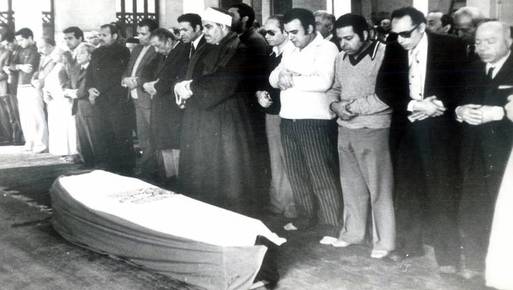
On Friday the seventeenth of February 1978, Youssef El-Sibai, the Egyptian Minister of Culture, arrived in the Cypriot capital, Nicosia, at the head of the Egyptian delegation participating in the Sixth Afro-Asian Solidarity Conference and in his capacity as Secretary-General of the Afro-Asian Solidarity Organization. But Al-Sibai did not know what fate had in store for him there. Sadat traveled to Jerusalem in November 1977, which prompted many Arab countries to sever their relations with Egypt. Al-Sibai accompanied President Sadat on his trip in his capacity as editor-in-chief of Al-Ahram newspaper. About three months later, Al-Sibai traveled to Cyprus despite all warnings, only to be assassinated by two Arab extremists. Muhammad Sobeih – Assistant Secretary-General of the League of Arab States: We asked – and I was one of those who insisted – that this meeting be held either in Moscow or Berlin, because there is protection. So we tried every way not to go to Cyprus, but Al-Sibai said, “I don’t want them to say that Youssef Al-Sibai is a coward and does not want to come.” Hassan Shash – former Egyptian ambassador to Cyprus: I was very surprised because Cyprus at this time was an island infiltrated by all intelligence services such as Mossad and British intelligence. Youssef Al-Sibai had visited Israel with President Sadat. The Egyptians received the news of the assassination of Al-Sibai with great shock, and early questions arose about the identity of the perpetrator of the crime, and speculation began pointing to the involvement of the Cypriot authorities and their complicity in order for the two extremists to succeed in carrying out their crime, especially in light of the absence of the necessary security to protect the conference. Al-Sibai’s killers claimed that they had killed him because he had gone to Jerusalem with President Sadat, and because, in their opinion, he had positions hostile to the Palestinian cause. The reports were contradictory, as it was initially announced that the two killers were Palestinians, and it later became clear that one of them was Palestinian and the other was Iraqi. The Palestine Liberation Organization soon denied its ties to the incident, while the Egyptian press insisted on accusing the organization of orchestrating the incident. Abdul Qader Yassin – writer and historian on Palestinian affairs: We followed the news. It turns out that there is a conference in favor of Palestine being held in a country friendly to Palestine, which is Cyprus, organized by an organization friendly to Palestine, the Afro-Asian Solidarity Organization, headed by a man friendly to Palestine, Youssef Al-Sibai. The Palestinians would not have killed this man with such a strong record behind him. After the assassination of Al-Sibai, the two killers took about thirty members of the delegations participating in the Solidarity Conference hostage and detained them in the hotel cafeteria, threatening to use hand grenades to kill the hostages unless the Cypriot authorities responded to their request to fly them out of the country. The Cypriot authorities responded to the two killers’ request and decided to take off on a Cypriot plane (DC8) from Larnaca Airport. The two killers released most of the hostages while continuing to hold eleven hostages, including four Egyptian hostages. Then the plane took off from Cyprus, but several countries refused to allow the hostages to land, including Libya, Syria, and South Yemen. After an emergency landing in Djibouti, it was decided to return the plane to Larnaca Airport. On the nineteenth of February 1978, funeral ceremonies were held to bury Youssef Al-Sibai. President Sadat did not attend the funeral, but he was represented by the Vice President of the Republic, Mohamed Hosni Mubarak, and the Minister of Defense, Mohamed Abdel-Ghani El-Gamasy.
Wait a while ***

21 responses to “How did he die: Continue the article”
I’m not familiar with Youssef El-Sibai, but this story is truly tragic. It’s heartbreaking to hear about how political tensions can lead to such violent and senseless loss of life.
Yes. That is a painful truth, my dear brother Willy Torres. I hope you have a good time. Thank you for your like
I was not aware of these events in your country. The death of El Sibai is very unfortunate because it brought political consequences in the region. A part of history that is good to know in detail to understand the present.
👋🏻May God protect and bless you, dear McAlder. My best wishes and prayers are for you
Thank you Noga for your good wishes
Your detailed account of Youssef Al-Sibai’s assassination sheds light on a pivotal and complex moment in history. You’ve masterfully woven together the political, personal, and regional dimensions of this tragedy, highlighting its far-reaching consequences. Your ability to present conflicting narratives and the broader geopolitical context is truly commendable. This piece not only informs but also provokes reflection on the challenges of leadership and the pursuit of peace in turbulent times. Keep sharing such insightful and thought-provoking work—it’s invaluable for understanding our shared history.
Thank you very much, I am honored to have a friend and brother like you, may God protect you and bless you
🙏👏🙌🙇🌷
Thank you so much for sharing an interesting story with us 🙋♂️
😍Thank you very much. Uğurcan bal. Happy Friday to you, Lord
Happy Friday. Thank you
Riveting account and very informative!
Thank you so much for coming. Have a nice day and good luck Balladeer